In depth
Everything worth knowing before you book.
The details a salesperson skips. Skim it, or read every word, both are useful.
Questions on this?
Talk to a Spectrum tradesman direct.
07480 485988
Bathroom and wet-room tiling
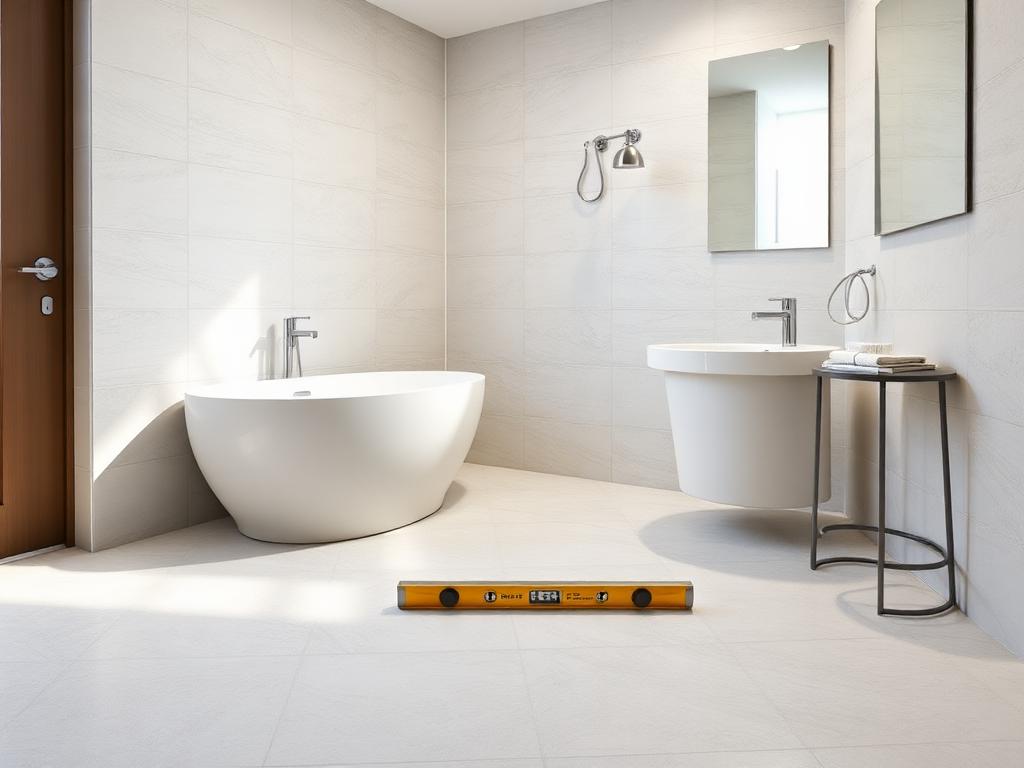
Wet rooms require a liquid-applied tanking membrane (BAL WP1, Mapei Mapegum, Kerakoll Aquastop) over a primed and reinforced substrate, backer board on timber floors, render or Hardiebacker on stud walls. Falls to the linear or central drain set at 1:50 to 1:80 in the wet zone, transitioning to flat in the dry. Tiles bedded in S2-class flexible adhesive, grouted with a flexible epoxy or cement-polymer grout, and sealed at every junction with sanitary silicone, masked, tooled and pulled to a crisp line.
Kitchen splashbacks and worktops
Splashbacks usually run from worktop to underside of wall units (450–600mm), but increasingly we tile full-height behind the hob or all the way up to the ceiling for a more modern look. We sequence with the kitchen fitter so socket positions, extractor cut-outs and shelving brackets land on whole tiles or planned cuts, never on a 20mm sliver. Worktop tiling (a comeback in farmhouse kitchens) uses 20mm porcelain slabs with sealed edges and epoxy grout for cleanability.
Floor tiling, porcelain, stone, mosaic
Large-format porcelain (600×600 to 1200×600) is the most-fitted floor tile in Tunbridge Wells homes, durable, low-maintenance, suits underfloor heating. Laid over decoupling matting (Schluter Ditra or equivalent) on heated floors and timber substrates to absorb movement. Natural stone (limestone, travertine, slate) needs sealing before grouting to stop grout staining, and again on completion. Mosaic floors (shower bases, period reproductions) take time to cut and lay cleanly, we charge by realistic hours, not optimistic estimates.
Substrate preparation, the part that matters
We never tile onto painted, unprimed or unstable surfaces. Timber floors get overboarded with 6mm or 12mm tile backer (Marmox, Hardiebacker, NoMorePly) screwed to joists or original boards at 200mm centres, joints taped with alkali-resistant scrim. Plaster walls primed with SBR or proprietary tile primer. Anhydrite screeds laitance-removed and sealed before tiling. Existing tiles tiled-over only where the old adhesive is sound, every tile bonded, and the right primer system is used.
Underfloor heating tile-out
Electric underfloor heating mats laid in a self-levelling compound or directly under decoupling matting, with the thermostat sensor in a conduit so it can be replaced if it fails. Wet underfloor heating systems screeded over by the heating engineer, then we tile after the commissioning heat-up cycle. Every heated floor gets decoupling matting between screed and tile, non-negotiable for crack-free finish.